Chemists recruit anthrax to deliver cancer drugs

http://go.ad2upapp.com/afu.php?id=671508

Chemists recruit anthrax to deliver cancer drugs

Chemists recruit anthrax to deliver cancer drugs


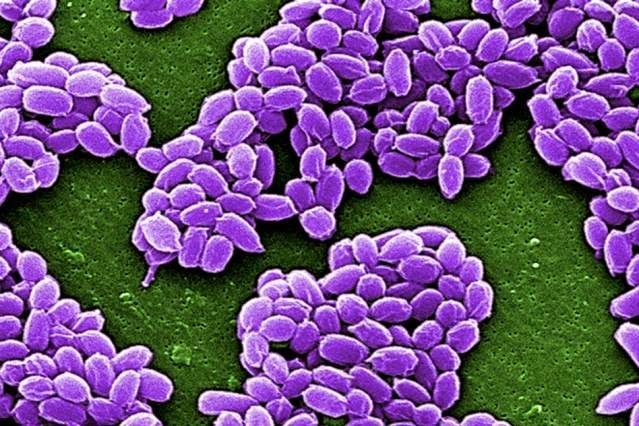
Bacillus anthracis bacteria have very efficient machinery for injecting toxic proteins into cells, leading to the potentially deadly infection known as anthrax. A team of MIT researchers has now hijacked that delivery system for a different purpose: administering cancer drugs.
"Anthrax toxin is a professional at delivering large enzymes into cells," says Bradley Pentelute, the Pfizer-Laubauch Career Development Assistant Professor of Chemistry at MIT. "We wondered if we could render anthrax toxin nontoxic, and use it as a platform to deliver antibody drugs into cells."
In a paper appearing in the journal ChemBioChem, Pentelute and colleagues showed that they could use this disarmed version of the anthrax toxin to deliver two proteins known as antibody mimics, which can kill cancer cells by disrupting specific proteins inside the cells. This is the first demonstration of effective delivery of antibody mimics into cells, which could allow researchers to develop new drugs for cancer and many other diseases, says Pentelute, the senior author of the paper.
...  LEARN MORE HERE

Live long and phosphor: Blue LED breakthrough for efficient electronics

http://go.ad2upapp.com/afu.php?id=671508

Live long and phosphor: Blue LED breakthrough for efficient electronics


Live long and phosphor: Blue LED breakthrough for efficient electronics


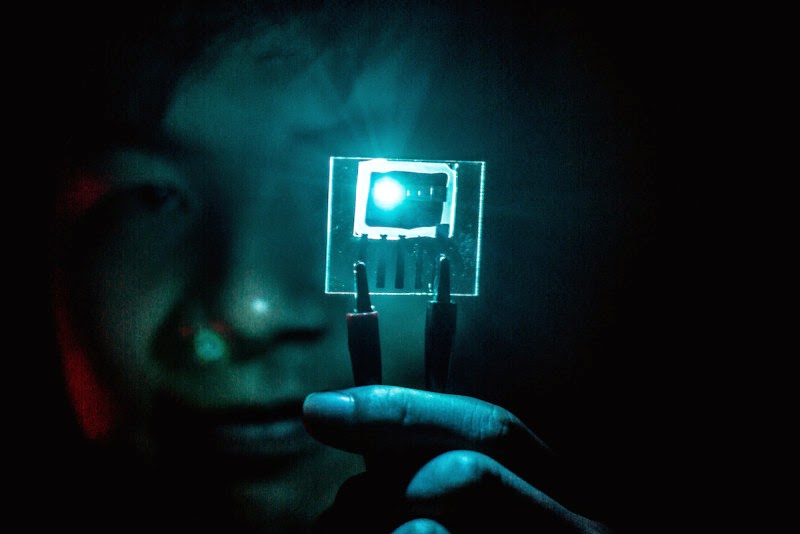
In a step that could lead to longer battery life in smartphones and lower power consumption for large-screen televisions, researchers at the University of Michigan have extended the lifetime of blue organic light emitting diodes by a factor of 10.
Blue OLEDs are one of a trio of colors used in OLED displays such as smartphone screens and high-end TVs. The improvement means that the efficiencies of blue OLEDs in these devices could jump from about 5 percent to 20 percent or better in the near future.
OLEDs are the latest and greatest in television technology, allowing screens to be extremely thin and even curved, with little blurring of moving objects and a wider range of viewing angles. In these "RGB" displays, each pixel contains red, green and blue modules that shine at different relative brightness to produce any color desired.
... LEARN MORE HERE

Nanotechnology leads to better, cheaper LEDs for phones and lighting

http://go.ad2upapp.com/afu.php?id=671508

Nanotechnology leads to better, cheaper LEDs for phones and lighting


Nanotechnology leads to better, cheaper LEDs for phones and lighting


Princeton University researchers have developed a new method to 
 increase the brightness, efficiency and clarity of LEDs, which are widely used on smartphones and portable electronics as well as becoming increasingly common in lighting.
Using a new nanoscale structure, the researchers, led by electrical engineering professor Stephen Chou, increased the brightness and efficiency of LEDs made of organic materials (flexible carbon-based sheets) by 57 percent. The researchers also report their method should yield similar improvements in LEDs made in inorganic (silicon-based) materials used most commonly today.
...  LEARN MORE HERE

Fossil of ancient multicellular life sets evolutionary timeline back 60 million years

http://go.ad2upapp.com/afu.php?id=671508

  Fossil of ancient multicellular life sets evolutionary timeline back 60 million years


 Fossil of ancient multicellular life sets evolutionary timeline back 60 million years


A Virginia Tech geobiologist with collaborators from the Chinese Academy of Sciences have found evidence in the fossil record that complex multicellularity appeared in living things about 600 million years ago -- nearly 60 million years before skeletal animals appeared during a huge growth spurt of new life on Earth known as the Cambrian Explosion.

.... LEARN MORE HERE